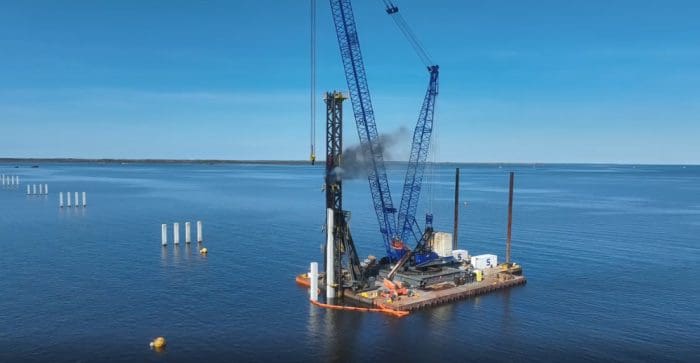
Pile driving for the new bridge over the Alligator River has resumed after a seasonal pause, and crews have now installed about 75 percent of the piles that will support the $450 million span.
In a project update shared on Monday on the N.C. Department of Transportation’s NC 12 Facebook page, the highway department said pile driving restarted last month and is expected to finish by spring, weather permitting.
In addition to pile work, crews have been conducting roadway earthwork on the west approach to the new bridge, installing pile caps, and began casting bridge girders last Friday.
The project marks a significant milestone for the long-awaited replacement of the aging Lindsay C. Warren Bridge, which carries U.S. 64 between Dare and Tyrrell counties.
The 3.2-mile, two-lane, fixed-span bridge will replace the existing swing-span structure completed in 1960, which remains a constant source of delays for motorists and boaters alike.
The new bridge will feature 12-foot travel lanes and 8-foot shoulders and will cross the river along a new alignment just north of the current bridge.
Pile driving was temporarily halted through September 30 because of an environmental moratorium, but other construction activities continued.
That included trimming piles, pouring concrete caps, installing temporary work trestles similar to those used at Oregon Inlet for construction of the Marc Basnight Bridge, and completing roadway work on the eastern approach.
The current bridge, completed in 1960, is the main route to access the Outer Banks from the west, and a critical hurricane evacuation route.
It has been a constant headache for travelers and the N.C. Department of Transportation, even after replacement of mechanical and electric systems during extensive renovations in the 2010s.
More than 4,000 boats pass through the bridge every year while traversing the Intracoastal Waterway, forcing vehicle traffic to stop while the swing-span opens and closes.
When the bridge malfunctions for extended periods of time, drivers must travel detours that are at least 99 miles long, either along U.S. 264 through Hyde County or U.S. 158 and U.S. 17 through Elizabeth City.
Plans have been formulated for years to build a fixed-span bridge over the Alligator River.
It was originally going to be a new four-lane span, and would have been the final piece of a complete four-lane highway between Raleigh and the Outer Banks.
It was paired down to a two-lane span because of a shift in how state highway funding is distributed in 2016, along with environmental concerns over widening U.S. 64 between Manns Harbor and Columbia.
The new Alligator River bridge will be a 3.2-mile-long, two-lane, fixed-span, high-rise bridge with 12-foot travel lanes and 8-foot shoulders, and cross the river at a new location just north of the current bridge.
Skanska USA began driving the first pilings for the bridge in February.
Under terms of the contract, the new bridge will open to traffic in the fall of 2029, with demolition of the current bridge to begin in the spring of 2030.
The post 75% of pilings driven for new Alligator River bridge appeared first on Island Free Press.

 Add to favorites
Credit: Original content published here.