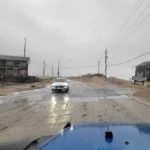
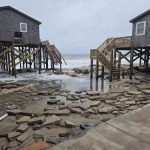
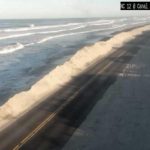
Dare County leaders opened Monday’s Board of Commissioners meeting with renewed explanations of what emergency declarations can and cannot do in the wake of accelerating oceanfront home collapses in Buxton, while residents urged the county to treat the situation as a disaster and expand debris-management and recovery coordination.
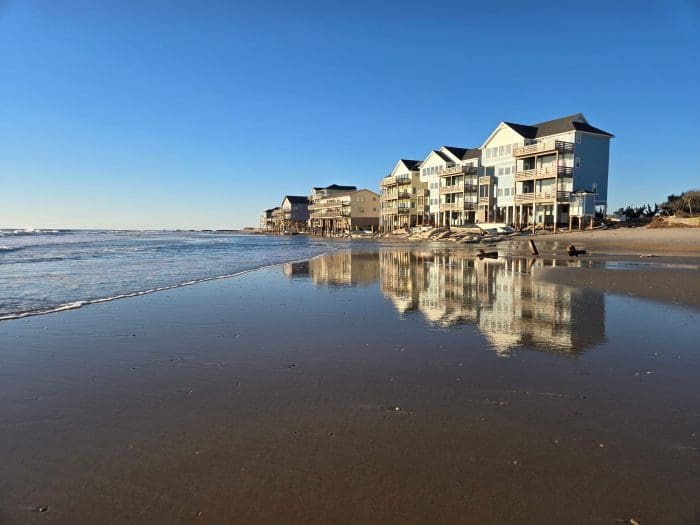
In a six-week timeframe, 16 oceanfront homes have collapsed on Hatteras Island — 15 in Buxton and one in Rodanthe — scattering debris across neighborhoods and the Cape Hatteras National Seashore, and prompting repeated N.C. Highway 12 closures.
Chairman Bob Woodard said the county is pushing every available lever to secure support and solutions, but emphasized the scale of the challenge. “We’re working ourselves to death daily trying to do something,” he told meeting attendees. “We need help. We cannot any longer do it on our own.”

State of Emergency clarification
Woodard opened his remarks by reiterating the purpose and limitations of the Governor’s State of Emergency declarations, citing the most recent declaration issued for Hurricane Imelda in September. He noted that many believe a state declaration unlocks various avenues of financial assistance, and asked County Manager Bobby Outten to address the misconception.
Outten explained that emergency declarations enable emergency operations and government-to-government support, not funding for private property losses. “The thought that somehow a state of emergency is going to come in and create a pot of money for individual people to use…that isn’t how that works,” he said. “The purpose is to protect the public’s safety.” He added that the county currently has the state resources it needs, and has not needed to issue a local state of emergency.

Private property rules and debris removal
With debris from collapsed homes now spread across shorelines, residential streets, and private lots in Buxton, residents and property owners urged the county to take a more active role in cleanup and coordination.
Outten emphasized that debris removal on private property remains the homeowner’s responsibility under state law and county policy, similar to post-hurricane practice. “If your house burns down, if your house falls in, it’s your responsibility to clean that up,” he said.
Outten also noted that the county cannot clean debris on federal land, and namely National Park Service property along the shoreline. According to the Cape Hatteras National Seashore (CHNS), homeowners are responsible for debris collection on seashore lands, however, owner-initiated cleanup efforts have not always adequately restored beaches, so the Seashore has supplemented cleanup activities and sought recovery for costs associated with additional beach restoration.
This overall situation of separation— private lots, state right-of-ways, and federal shoreline — continues to complicate cleanup as wreckage spreads across multiple jurisdictions after each coastal storm.
However, the county is in the process of coordinating roadside debris pickup for Buxton, giving property owners until November 17 to move debris to the right-of-way along Old Lighthouse Road
Calls for on-the-ground leadership
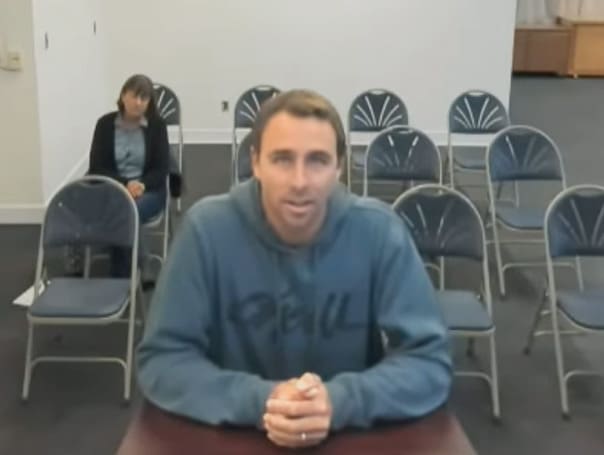
Buxton resident and Buxton Civic Association board member Brett Barley described near-daily flooding, property loss, rescue efforts, and exhaustion in the community, stressing the need for disaster-style coordination.
“This is insane. This is no way for us to operate,” he said. “There’s nothing to stop the water. This is not like anything we’ve ever seen. This is a completely different situation.”
Barley urged the county to designate a coordinator to oversee logistics, planning, and cleanup moving forward, saying, “We can’t just keep waking up every day and be like, ‘Okay, well five houses fell, now what do we do?’”
Buxton property owner Betsy Gwin told commissioners the debris situation has been overwhelming and inconsistent, and asked for a clear point person. “It is a circus without a ringleader,” she said.
Why nourishment and hardened structures aren’t happening now
The next Buxton beach nourishment cycle has already been accelerated to summer 2026, but Outten stressed that dredging can’t occur during the winter months due to ocean conditions. He cited past projects where contractors were forced to halt work until spring because of wave height and storm risk.
Residents again pushed for hardened structures, but Outten and commissioners emphasized that North Carolina’s Coastal Area Management Act (CAMA) prohibits permanent oceanfront erosion-control structures such as groins and jetties.
“We can’t go in and build groins,” Outten said. “You can’t just go on federal property and do what you want.” Federal land at Cape Hatteras National Seashore and Pea Island further restricts construction.
A lone jetty replacement is scheduled for the summer of 2026, to hopefully coincide with the next round of Buxton beach nourishment.
Legislative push and long-term planning
Woodard said the county will formally press state lawmakers to fund North Carolina’s long-promised coastal beach nourishment fund and eliminate the statewide ban on groins and jetties. He noted this request will go to every member of the General Assembly, and that the county is prepared to take residents to Raleigh if needed.
Commissioner Mary Ellon Ballance said county officials are coordinating daily with state and federal partners, from N.C. Department of Transportation engineers to congressional liaisons. She acknowledged residents’ frustration, stating, “Everything that we are possibly in our power to do is being done,” but warned that conditions will likely worsen before long-term resilience measures take effect.
What happens next
County officials will continue working with state and federal agencies on future N.C. Highway 12 protection strategies, including short-bridge segments around high-risk areas, and possible westward road relocations near the Pea Island Visitor Center.
Stormwater and dune maintenance will proceed where permitted, and roadside debris removal will begin November 17.
Meanwhile, planning and permitting for the 2026 Buxton beach nourishment project are underway, and county leaders will intensify pressure on Raleigh for coastal infrastructure funding and flexibility. Commissioners stressed that the county remains engaged daily and will continue pushing for both immediate relief where legally possible and long-term coastal protection solutions.
But for coastal residents who have been living this reality since August’s Hurricane Erin, solutions can’t come fast enough. As Barley told commissioners, the daily struggle is wearing people down. “Everybody’s exhausted,” he said. “We’ve spent most every week for the last two months navigating when to go get groceries because the high tide… people getting stuck on and off the island, people helping other people clean up properties.” He added that without timely intervention, “It’s going to get worse… Our little community can’t do it alone.”
The post Dare commissioners explain limits, outline next steps as Buxton erosion emergency grows appeared first on Island Free Press.

 Add to favorites
Credit: Original content published here.