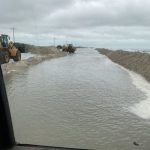
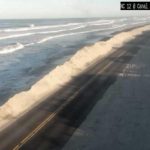
When Lat and Debby Williams first stayed on Hatteras Island more than forty years ago, they couldn’t have imagined that the ocean waves—then buffered by two rows of homes, a sand dune, and a wide beach—would one day threaten to take their home away.
Back in 1981, Buxton felt like a remote destination—wild, serene, and far removed from the bustle of Charlotte, where they lived and worked. Debby’s parents loved to surf fish, and when they bought a small, cedar-shingled beach cottage that year on Cottage Avenue, it became an anchor for the family’s summers.
“It was such a family tradition—three or four generations have stayed there since they bought the house in 1981,” said Lat. “When she was little, my granddaughter used to come back from the beach, covered in sand, and half of it would end up on the floor. She’s in college now, so she might not be able to visit as much, but she used to stay with us for a month every summer… It has been such a great place for us.”
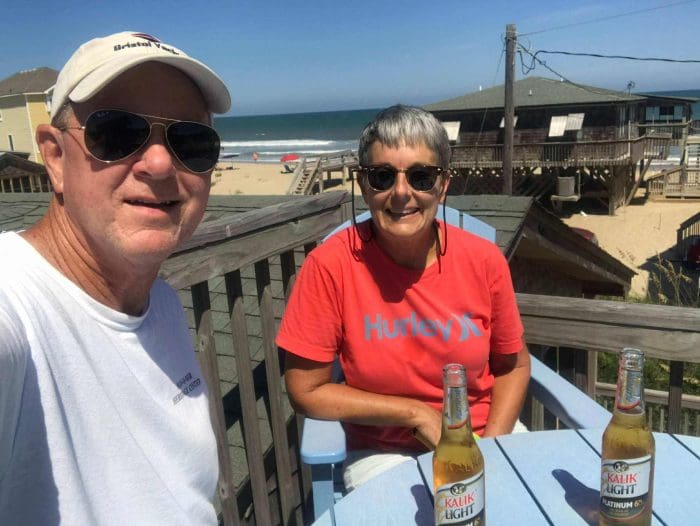
The house itself was simple: three bedrooms, two baths, baseboard heat, and no air conditioning, just ceiling fans and cross breezes. It was built in 1975, a solid beach box of its time.
In those early years, the home was located three lots away from the ocean, which felt impossibly far away. “Back then, there was also a huge dune in front of it,” Lat said. “People complained it was too far to walk—you had to pack a lunch to go to the beach.”
When the couple retired after long careers in the commercial insurance industry, they decided to make Buxton their permanent home. In 2017, Lat and Debby left Charlotte behind and moved into the cottage full-time, transforming the family getaway into their year-round residence. What had once been a place for summer visits and Thanksgiving weekends became the center of their lives – a quiet stretch of Cottage Avenue where they expected to spend the rest of their retirement close, but not too close, to the ocean.
Over time, though, the shoreline began to change. Little by little, storms stripped away the dune line. As years passed, the “safe distance” between the cottage and the surf shrank until, this fall, the Atlantic was washing beneath their front steps.
Since mid-September, 15 oceanfront homes in Buxton have collapsed into the Atlantic—along with one more in Rodanthe—marking one of the most accelerated periods of erosion and home loss Hatteras Island has experienced in modern memory.
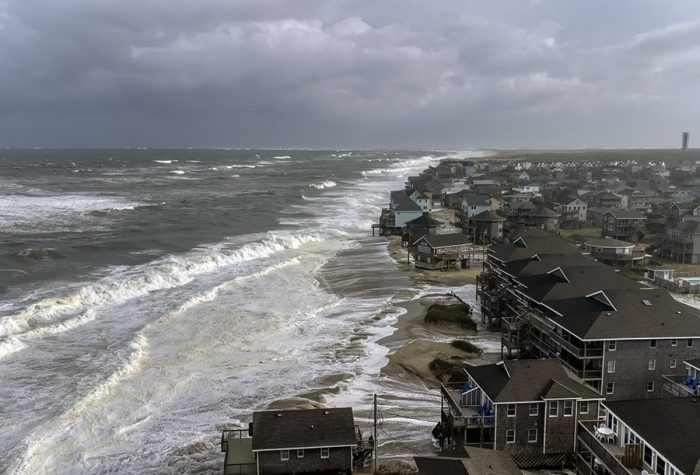
Videos of collapsing houses have become viral images, but for people who live here full-time or who have generational family homes, it’s far from a spectacle – it’s painfully real.
“This whole experience has been constantly unnerving,” said Lat. “Watching all our friends’ houses falling—it’s devastating.”
By late summer, the waves were eating through dunes that had stood for decades. When the remnants of Hurricane Erin brushed the Outer Banks in mid-August, the sea took their outdoor shower, a chunk of their steps, and their septic tank within a day.
“It was getting worse, and our pastor at Cape Hatteras Baptist Church invited us to stay at the guest house,” Lat said. “He told us, ‘You don’t need to be over there.’”
For weeks afterward, without a working septic system and barley-there stairs to access their home, they moved from house to house, staying in friends’ unoccupied rentals. “We’ve been nomads,” said Lat, “but we’re very fortunate to have such good friends who welcomed us and told us to make ourselves at home.”
Each time they came back to check on their own house, more sand was gone, more debris littered the shoreline, and more neighbors’ homes had vanished. “We were in another friend’s house nearby when one of our friend’s homes fell,” said Lat. “It was the eighth one to go. We heard and felt this big thump, and I walked on the deck and looked out at the ocean, and it was just sitting straight up in the water. By the next morning, it had broken apart completely.”
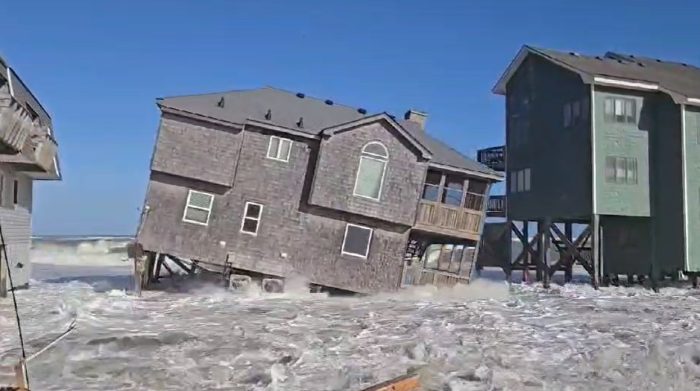
For the Williams and many other Buxton residents, the losses weren’t abstract because they were happening to friends and neighbors who had been part of the same close-knit community for decades. “When people comment that these are just investment properties or rental houses owned by millionaires, it’s frustrating, because it’s just not that way,” said Lat. “Those homes were full of fishing certificates, family photos, mementos – They might have been rented, but they were still someone’s family home, and you could tell it was a family home as soon as you walked inside.”
When the storms kept coming in September and October, there was no chance to catch a break. Each nor’easter cut deeper into the shoreline. By late October, Lat and Debby were out of options. “After the first wave of houses fell, Debby said, ‘I’m not sure my nerves will take it.’ That’s when we decided we had to look for a new lot.”
They found one through a friend, Wendi Munden, who told the Williamses about a couple who had lost their mountain home in Chimney Rock during 2024’s Hurricane Helene. The couple also happened to own a vacant lot in Buxton, and after reading about the local shortage of safe relocation sites, they decided to offer their property so someone in need could use it as a potential lifeline. “They put a very reasonable price on it, and we made an offer that same day,” said Lat.
But even with a new lot secured, there was still the question of how to move the home before the ocean took it.

October 28 brought the worst blow yet when five houses collapsed in one day. “When the house next to us went down, I called Debby and said, ‘I’m sorry—we’re going to lose the house,’” Lat said. “I was sure it would be gone within an hour.”
By morning, the house was somehow still standing. Beneath it, the ocean has carved away nearly everything holding it up. “Whatever debris went under our house after those five collapses—maybe part of a roof or deck—it took out all but one piling that supported a third of our home,” he said. “It was just hanging there.”
That’s when local contractors Todd Gaskill and his son Cullen Gaskill with Top Dollar Construction stepped in. They had been on the front lines of Buxton’s erosion crisis for weeks, hauling debris from previous collapses.
For Todd and Cullen, the project to keep the William’s home standing became something more than just clearing debris. After so many losses, Lat believes they were simply looking for some sort of a win—a small bit of progress in a season filled with setbacks. “They’d seen so many houses go down that couldn’t be saved,” he said. “Ours still had a chance, and I think they wanted to see that story end differently.”
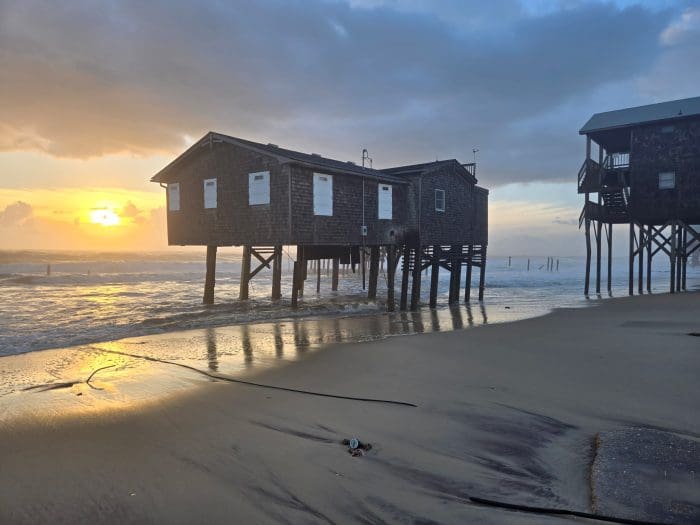
The Gaskills worked to reinforce pilings that had been cracked or undermined by the surf. On three separate occasions, they “sistered in” new supports to replace or strengthen those that were missing, sometimes wading into the surf to do it. Every day was a gamble; one strong tide or overnight storm could have sent the house into the ocean before it was ready to move.
“They were working in chest-high waves,” Lat said. “It was heroic. Cullen just made it his mission to help save our house.”
In early November, Gabor Tarjan of ACE House Movers and local contractor JT Malys joined in the efforts to save the home and move it inland, forming a small and determined team.
Within days, steel beams were slid under the house, pilings were cut, and the entire structure was carefully rolled onto wheels. The first leg of the move was to the end of Cottage Avenue, where the house now sits temporarily until the weather conditions allow it to be placed on its new lot along Diamond Shoals Drive.
The process was expensive—about $55,000 for the move itself, plus the cost of the lot, foundation, and new septic, water, and electrical systems. “The insurance doesn’t provide much of anything—potentially zero, and at most $30,000,” Lat said. “The lot was a good price, but it was still six figures. It’s putting a dent in our retirement funds. It’s doable, but it hurts.”
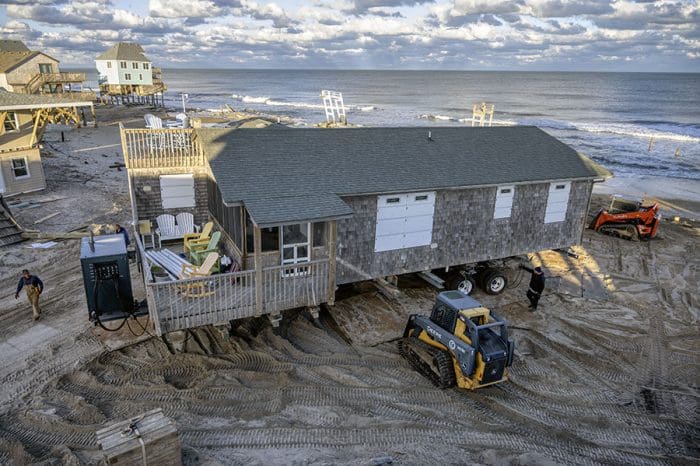
Yet, for Lat and Debby, there was no question that it was worth doing. “People ask if it would be cheaper to build a new house,” he said. “Maybe. But we’re not going to let our house fall and dump debris in the ocean. We’re not losing our belongings or the house we love. Nobody wants their house to fall in.”
For Lat, who spent his career in commercial insurance, the experience has made him determined to advocate for change. “The incentive for homeowners right now is to let the house fall in,” he said. “If it collapses, you can get up to $100,000 for contents and $250,000 for the house—so $350,000 total. If you try to move it, you might get $30,000, and that’s not guaranteed.”
He’s been in touch with state leaders, including North Carolina Insurance Commissioner Mike Causey, pushing for a policy shift that rewards homeowners for relocating or demolishing at-risk homes instead of waiting for them to fall, or at the very least, gives them more financial breathing room to do so.
“If they increased the benefit for moving a house to $100,000, you’d save everyone money,” he said. “If 100 homeowners moved instead of letting their houses fall, that’s $250,000 saved per house. No debris, no pollution, no homes lost, and the insurance companies benefit —it’s a win-win. The current system punishes the people trying to do the right thing.”
Williams noted that a similar incentive once existed, namely the Upton-Jones program in the late 1980s and early 1990s, which paid homeowners to move or demolish homes in imminent danger. “It was poorly written and got abused,” he said. “But the idea was sound. It just needs to be done right this time.”
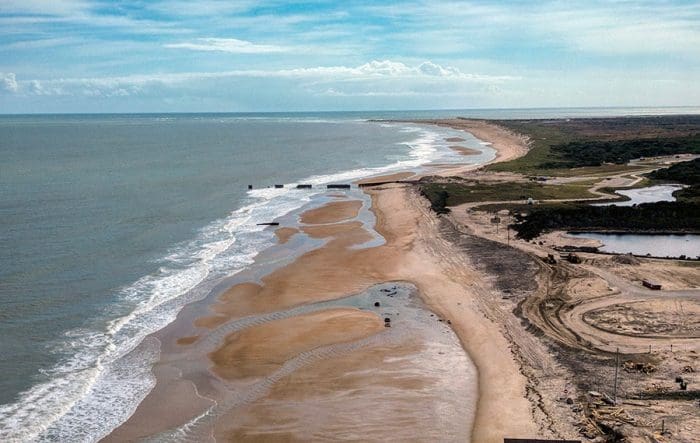
Beyond the insurance issue, he also believes the deterioration of the three nearby jetties – built by the U.S. Navy in 1969-1970 to protect their adjacent military base – are contributing to the rapid erosion in Buxton, based on 44 years of first-hand Buxton shoreline observations.
“The jetties are the difference,” he said. “When those jetties were intact, the beach held. From the [early 1970s] to the late 1990s, it was stable. After the lighthouse was moved in 1999, and the jetties were left to deteriorate, the erosion just skyrocketed. I really do attribute about 90% of what’s happening here to that.”
He’s quick to acknowledge that jetties are controversial, but he believes Buxton’s situation is unique. “I understand the give and take of jetties—on the upstream side you gain, on the downstream side you lose,” he said. “But here, there’s nothing downstream. No businesses, no homes. Repairing them could do a lot of good and very little harm.”
For now, though, the Williamses are focused on getting back into their home, hopefully by January. “There’s some repair work that needs to be done, and we still have to get water, electric, and septic systems in,” Lat said. “If we can be in by the first of the year, that would be great.”
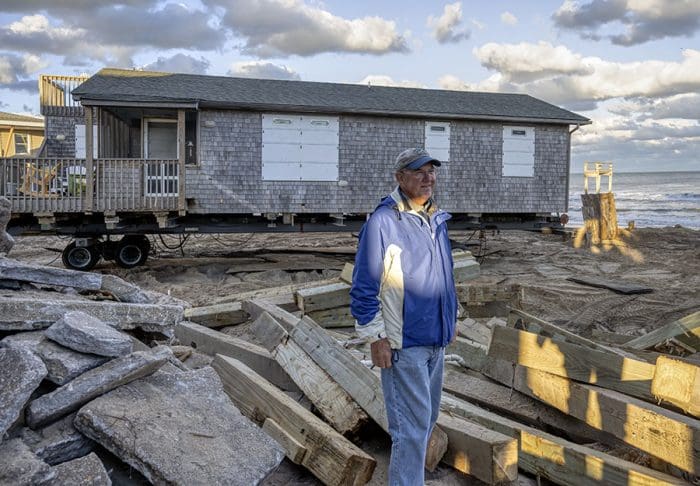
Even after the constant stress over the past three months —the storms, the uncertainty, the financial strain—leaving Buxton was never on the table.
At 70 years old, Lat knows that life on a barrier island isn’t easy, and requires sacrifice and adaptation. “There are plenty of times when there’s no getting off this island,” he said. “You have to take that into consideration as you age. But even with that, this is where we want to be…
“We came down here for the beach,” he said, “but we’ll stay because of the people. This is our home.”
For the Williamses, moving their house wasn’t just about saving a structure—it was about preserving a life and generations of family history. In a season defined by loss, their story is a rare success, but Lat says lasting change will only come through policy reform. “Nobody wants the house to go in,” he said. “No one wants to lose their home or their belongings, and no one wants the pollution—not the owners, not the community, not the government, and not the Park Service. And yet they don’t give you the opportunity to move it.”
“You can get $350,000 [in insurance reimbursement] if your house collapses into the ocean, but maybe $30,000 if you try to move it,” he said. “If they raised that to $100,000 for homes in imminent danger, more people would act before it’s too late.”
The post From the edge of collapse to safer ground: Buxton couple rescues family home appeared first on Island Free Press.

 Add to favorites
Credit: Original content published here.