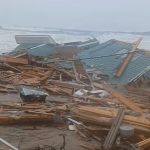
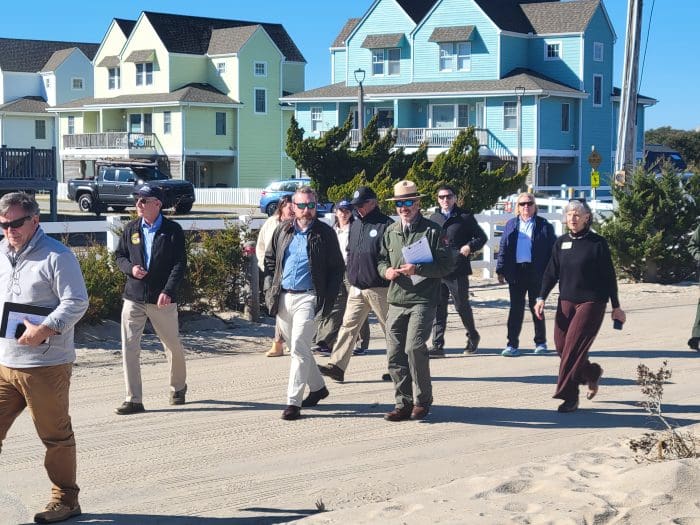
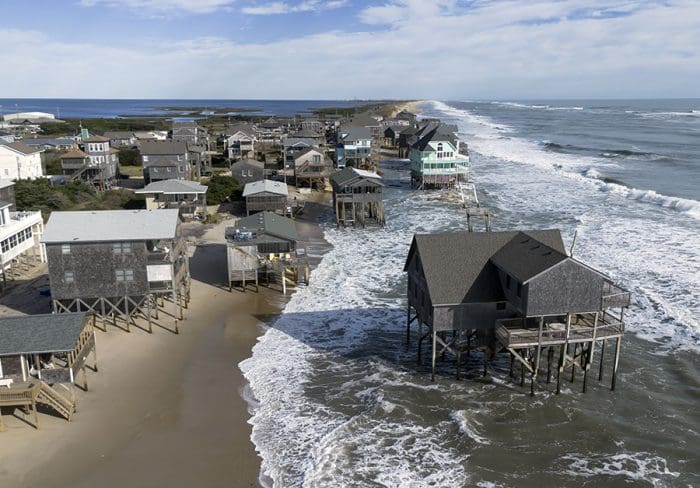
A delegation of roughly two dozen local, state, and federal officials toured the rapidly eroding Buxton shoreline on Monday, walking through the area where 15 oceanfront homes collapsed over a six-week span in the fall, and where dozens more remain at risk.
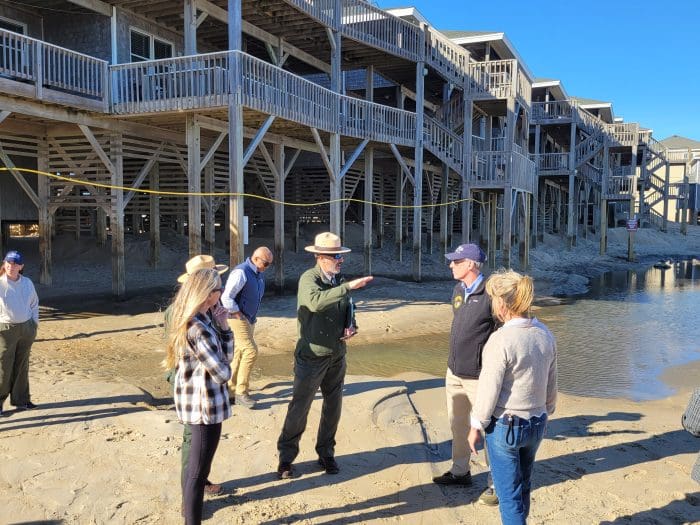
North Carolina Department of Environmental Quality (NCDEQ) Secretary Reid Wilson visited the Buxton Formerly Used Defense Site (FUDS) property and the adjacent beach community, alongside representatives from the National Park Service, Dare County Board of Commissioners, the Buxton Civic Association, Governor Josh Stein’s office, the N.C. Division of Coastal Management, and a 10-member team from NCDEQ.
Dare County Commissioners Bob Woodard and Mary Ellon Ballance, Cape Hatteras National Seashore Superintendent Dave Hallac, NCDOT Board of Transportation representative Tess Judge, and Dare County Manager Bobby Outten were among those in attendance.

Officials described the visit as an important step toward aligning local, state, and federal decision makers on a coordinated response. As Tess Judge noted, “It’s a positive thing to have all the stakeholders in one place – they all have to be here and work together to be able to make changes.”
Allan Holmes, NCDEQ Director of Public Affairs, stated that the driving force behind the visit was to get an on-the-ground perspective of the ongoing erosion problem. “It’s one thing to see pictures and videos,” he said. “But it’s much different to come out here and see it in person.”
The group walked the shoreline from the former Navy and Coast Guard base area to the northern end of the village, navigating hazardous conditions around leaning decks, exposed septic systems, sandbag barriers, and unstable sand. “It’s been extremely dramatic and difficult for everybody in this area,” Hallac said during the tour. “And you can see that there are more houses that are in danger of [falling].”
Buxton Civic Association members pointed out sites of several homes that had been relocated inland by owners attempting to save their properties, though there is not much room to move. “People are taking measures to move back, but there’s just not enough resources for everybody,” said Buxton Civic Association Secretary Wendi Munden.
Wilson said his goal was to see the situation firsthand and better understand what actions NCDEQ can support. “I want to see a number of projects for this [situation],” he said. “We have been discussing different potential approaches today that could help, and we’re going to continue to have those discussions.”
He also noted that the Coastal Resources Commission (CRC) took a significant step last week by directing its Science Panel to begin reviewing shoreline stabilization options beyond traditional beach nourishment.
“At our coastal resources commission meeting, [the members] decided that the science panel was going to look at potential options for threatened structures,” Wilson said. He added that the effort builds on a 2024 National Park Service report outlining possible alternatives for critically eroding zones such as Buxton.
The CRC decision is viewed locally as a notable development because hardened structures—like jetties and groins—are largely prohibited under North Carolina law, leaving beach nourishment as the primary tool available for protecting vulnerable communities like Hatteras and Ocracoke Islands. A broader review could open the door to additional strategies that have long been off-limits.
In the near term, Dare County is advancing two major projects: repairing one of the deteriorated jetties near the original Cape Hatteras Lighthouse site, and launching a large-scale beach nourishment effort for Buxton and Avon.
Bobby Outten said all permit applications are in progress, and the county hopes to begin work in the spring of 2026. “All the permit applications are in, and we’re waiting to get approval from all the [involved agencies] with the idea of starting this in the early spring,” he said. Wilson echoed that the state is also trying to identify every possible avenue of support, including emergency authorizations and resilience funding.
“One important thing is that recently Governor [Stein] and Insurance Commissioner [Causey] sent a joint letter to Congress urging them to pass Congressman Murphy’s bill that would make it possible for homeowners here to receive insurance money to take down their houses rather than wait for Mother Nature to take them, which is much more environmentally safe.”
Wilson also highlighted recent resiliency grants issued by the N.C. Resilient Coastal Communities Program (RCCP), which included nearly $6 million in awards to 32 coastal communities in November. Dare County has been the recipient of several of these grants over the years, which include funds for stormwater mitigation projects in Hatteras and Salvo.
Though the damage in Buxton was noticeably severe on Monday’s tour, several participants said the visit represented a breakthrough. “We’re working very, very diligently… every single day,” said Woodard. “Every day we’re talking to somebody, and doing something to try to make solutions happen.”
Others agreed that the tour showed the scale of the problem in ways no drone footage or social-media clip could. As Holmes remarked, “It’s really helpful to see it firsthand. You have to be here to understand what this community is facing.”
The post NCDEQ Secretary tours Buxton’s shoreline as key stakeholders weigh next steps appeared first on Island Free Press.

 Add to favorites
Credit: Original content published here.