


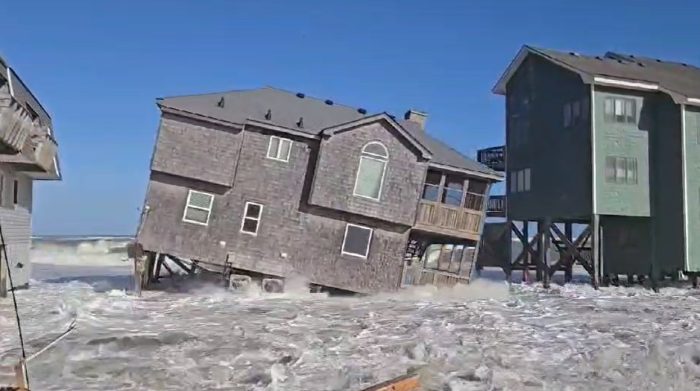
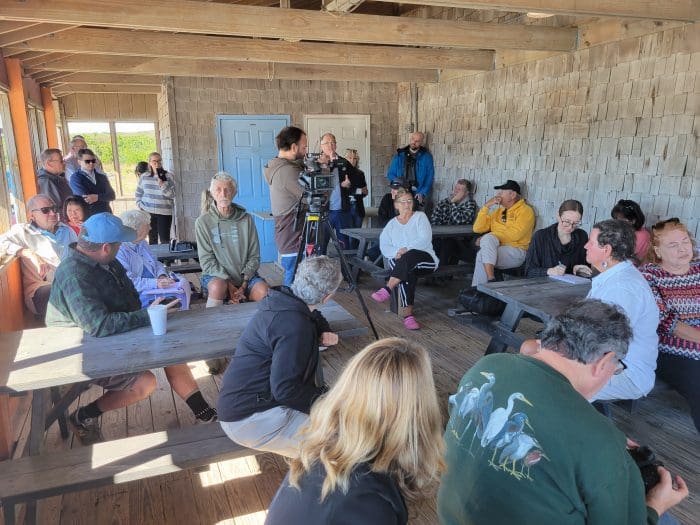
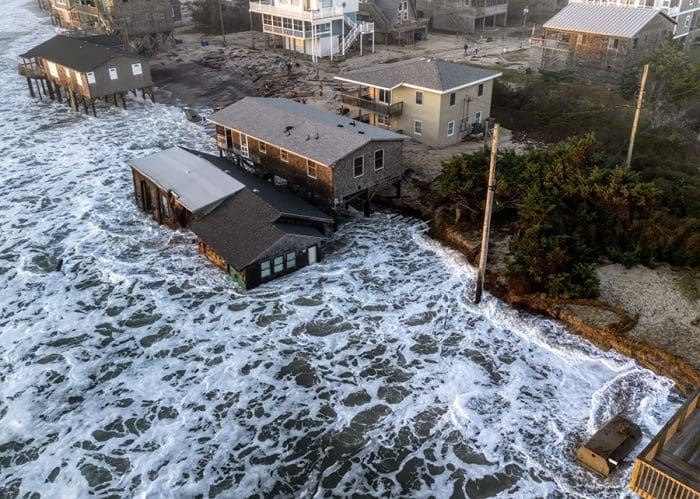
North Carolina Insurance Commissioner Mike Causey met with Hatteras Island residents in Buxton on Monday to discuss ongoing coastal erosion and insurance challenges following the collapse of 11 oceanfront homes — ten in Buxton and one in Rodanthe — since mid-September.
The community meeting brought Causey face-to-face with residents seeking state-level advocacy for what has become an increasingly urgent federal issue.
Causey, who also serves on the state’s Council of State alongside the governor and other statewide elected officials, told attendees that while his department regulates the insurance industry, it does not control flood insurance, which falls under the National Flood Insurance Program (NFIP).
“I don’t have a solution, but I have a voice,” Causey said, noting he intends to raise Hatteras Island’s erosion and insurance concerns with the governor and other state leaders. “We’ve got to get the legislature, the governor, and Congress involved… This is something I’m willing to tackle and talk about.”
The visit follows weeks of growing frustration from residents after repeated home collapses left debris scattered along the shoreline and prompted multiple National Park Service cleanup operations. Causey toured the Buxton area with Buxton Civic Association board member Jeff Dawson to view the damage and understand its impact on homeowners and the local economy.
During the meeting, residents pressed Commissioner Mike Causey on stalled federal legislation introduced by Greg Murphy (R-N.C.) that would allow homeowners in high-erosion coastal zones to access a portion of benefits from the National Flood Insurance Program (NFIP) before their homes collapse.
The bill, introduced in June 2024 with bipartisan support, would enable eligible property owners to use up to $250,000 from NFIP payouts to relocate or safely remove oceanfront structures at risk of imminent failure, rather than waiting for a collapse to trigger the claim.
This idea is not entirely new. During the late 1980s and early 1990s the NFIP included the Upton‑Jones Amendment, which allowed payments for demolition or relocation of homes threatened by erosion or undermining, but the program was repealed in 1994 after only a few years of operation.
“Congressman Murphy can have a good idea, but until he sells the legislative leadership, it’s not going anywhere,” Causey said. “We’re a regulatory agency — we don’t make laws, but we enforce them. Still, I’m happy to lend my voice to move things forward.”
Residents and civic leaders emphasized the economic stakes of inaction, citing Hatteras Island’s role as a major tourism engine for Dare County and the state.
Meeting organizer Marcie Shoemaker pointed out that Dare County generated $2.1 billion in visitor spending in 2024, with nearly a quarter of that revenue coming from Hatteras Island. “Why are we not getting any help?” she asked during the discussion. “This is not just a local issue — it’s a state and national issue.”
Causey said his department has strong relationships with FEMA and federal regulators, having worked with them following Hurricane Helene in western North Carolina, and pledged to help connect Outer Banks officials and residents with federal contacts. “We can get you some contacts at FEMA,” he said. “You’re doing the right thing by having meetings like this and keeping the issue in front of people.”
Several residents asked whether Causey would use his Council of State position to raise Hatteras Island concerns directly with Governor Roy Cooper. Causey explained that while the council typically votes on property and administrative matters, members can use the platform to share issues of statewide concern. “At the end of the meeting, we each get to speak for a few minutes,” he said. “That’s the time when I’ll make a comment about being in Buxton and what’s happening here.”
Others asked if insurance companies might soon stop covering coastal properties altogether, given the mounting risks. Causey said some carriers have already scaled back coastal policies in other states and noted that North Carolina law requires insurers to participate in a statewide “rate bureau” system that governs rate increases. “If they see a lot of risk, they’re going to pull out,” he said. “I’d like to see legislation that says if you’re going to write in Charlotte or Raleigh, you’ve got to write in the whole state.”
Despite acknowledging the complexity of the issue, Causey said the key to progress will be sustained public pressure and bipartisan cooperation.
He encouraged residents to write letters to the governor and copy the entire Council of State, as well as North Carolina’s congressional delegation. “The squeaky wheel gets the grease,” he said. “The more people who reach out, the harder it is for them to ignore.”
The roughly two dozen attendees thanked Causey for making the trip and said they hoped the visit would mark the beginning of stronger state-level support for addressing coastal erosion, insurance reform, and the long-delayed removal of collapsed homes.
“We’ve been screaming [about this] for decades,” Dawson said. “It’s just hard to get to the right people to listen. Maybe this meeting helps change that.”
The post NC Insurance Commissioner visits Buxton, says federal action needed after 11 home collapses appeared first on Island Free Press.

 Add to favorites
Credit: Original content published here.


